We are Living in a Digital World, and I am a Digital Girl
You Know What They Say About Assuming
I spend a lot of time reading and writing about the internet, information and communication technologies (ICTs), social networks, and the shapes and flows of knowledge through them. I want to know where ideas live. I want to know where information comes from, where it goes, who gets to see it, who gets to make it, who is impacted by it.
And sometimes, I just want to read Roxane Gay's hot takes on the news of the day.
As a digital pedagogue, I am hyperaware of the time I spend online and constantly curious about how learners and educators migrate and settle in to the internet. It's a vast ocean out here, where information forms, formats, and flows - and even function- are changing in step with technology. The way today’s learners and researchers need to receive, produce, and engage with information demands new approaches to the delivery of curriculum and the ways in which data is collected, analyzed, and interpreted in research - across all disciplines.
It's tempting to lean in to the notion that today's students are by and large digital natives - that anyone
between the ages of 5 and 25, by virtue of their birth year, is everything but genetically connected to digital technology. This is a fraught assumption, as many found out during the height of COVID-19 school closings. Dr. Kathryn Kennedy detailed some of these problems in her article Don’t Assume Students & Teachers Are Digital Natives:
between the ages of 5 and 25, by virtue of their birth year, is everything but genetically connected to digital technology. This is a fraught assumption, as many found out during the height of COVID-19 school closings. Dr. Kathryn Kennedy detailed some of these problems in her article Don’t Assume Students & Teachers Are Digital Natives:
We cannot assume that students have access to technology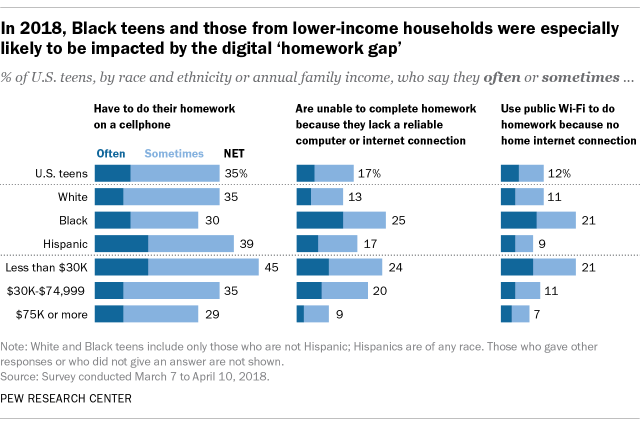
Image Source: Link - We cannot assume that students know how to use technology, and we cannot assume transference of technology skills across contexts
- Similarly, we cannot assume teachers (even those in the age range of 'digital natives') have access to and know how to use technology - for teaching or for learning
- We cannot assume that students or educators enjoy using technology in teaching and learning
In brief, as librarians and educators we need to consider the foundational aspects of information seeking as we think about integrating technology into learning: access, literacy, equity, and context.
A Different Approach: Digital Visitors and Digital Residents
When we step away from the "digital native" myth, we can start to think about how and where we and our learning communities live in the digital world. The typology of Visitors and Residents developed by David S. White and Alison Le Cornu is a useful framework for understanding digital behaviors and literacies within and between contexts. In the video below (under 10 minutes), White explains how the Visitors and Residents (V&R) model provides a framework to understand individuals' engagement with the Web based on motivation and context
Video Source: Link
The V&R Model in Action: Using Myself as a "Case Study"
The Visitors & Residents mapping process is a way to reflect upon and share our individual modes of online engagement. Beginning with a simple quadrant-style chart, either hand-drawn or created using a digital tool, you are challenged to remember all of the technologies you use in your personal and professional (or scholastic) life, and whether your engagement is as a visitor or as a resident.
As an example, here is my digital map:
.jpg) |
| Image Source: Author |
- In my professional context, my 'resident technologies' include both communication tools like Zoom, Teams, and Slack, as well as collaboration tools like Canva, Miro, and Google Docs.
- In my personal life, almost all of my resident technologies are about social engagement and personal communication.
- There is no overlap in communication technologies between my professional and personal contexts. This is absolutely on purpose, and has taken years of experience and reflection to create.
- Most of the tools in my professional context are used for finding information and resources I need to do my work. On the borderline between visitor and resident, though, is Quickbooks. This is a tool I use both for private recordkeeping and for sending out invoices to my clients - so the line gets a little blurred.
- The tools in my personal context are those that I use for finding and saving information, private entertainment, and general life logistics like directions and weather reports.
- There are a few social networking tools within or close to the visitor side of my chart. I am a top-tier lurker and will own that through and through.
What's Your Story?
Digital mapping and the V&R model is a simple way to build empathy and understanding about the varying levels of access and contextual experiences our learning communities have with technology. Here are a few resources that can help you learn more:
- White & Le Cornu's scholarly article, Visitors and Residents: A new typology for online engagement
- A quick-read blog White wrote for the Guardian describing the V&R model
- White's Padlet showing digital maps of many types and formats
Where are you spending most of your life online? I'd love to hear!
.png)
Thank you for a thoughtful reflection of the concept of Visitors & Residents, Liz. Your map is very neatly arranged! Thanks, as well, for including several resources to help us gain a better understanding of this concept.
ReplyDeleteLiz - I am obsessed with your title! So clever! Definitely invited me into reading your blog! I love that you use Google Calendar. I have wanted to convert to an electronic calendar for years, but I have committed so much to my paper calendar! My friends and family say my calendar makes it easy for me to say no to invites, if someone asks me to hang out and I don't have my planner, I always respond with, "Oh, I'll have to check my planner" and then I can decide if I really want to go to wherever I was invited! haha! Great blog! Very thought provoking!
ReplyDelete